

11 — What we build
Forecourt canopies.
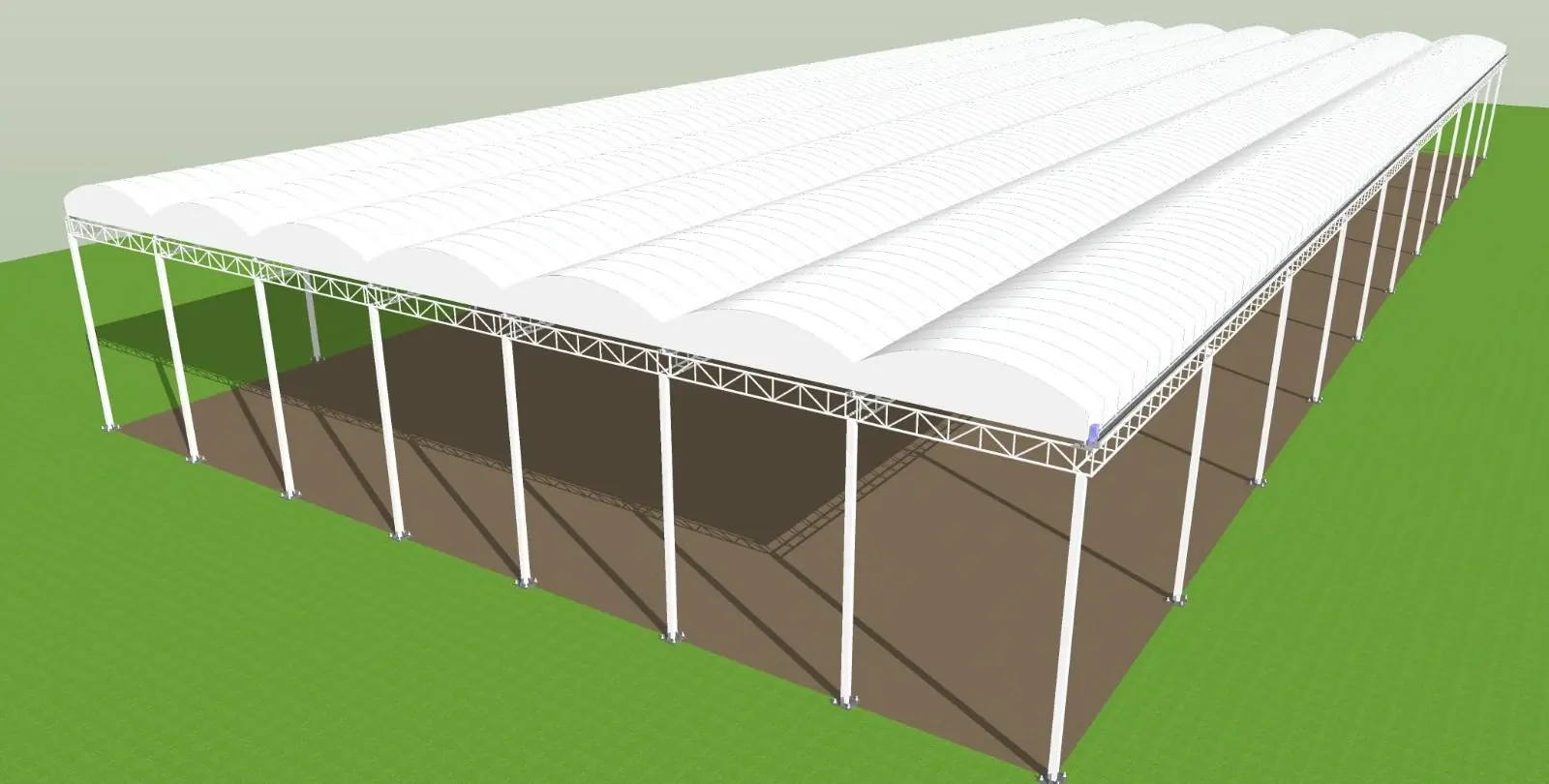
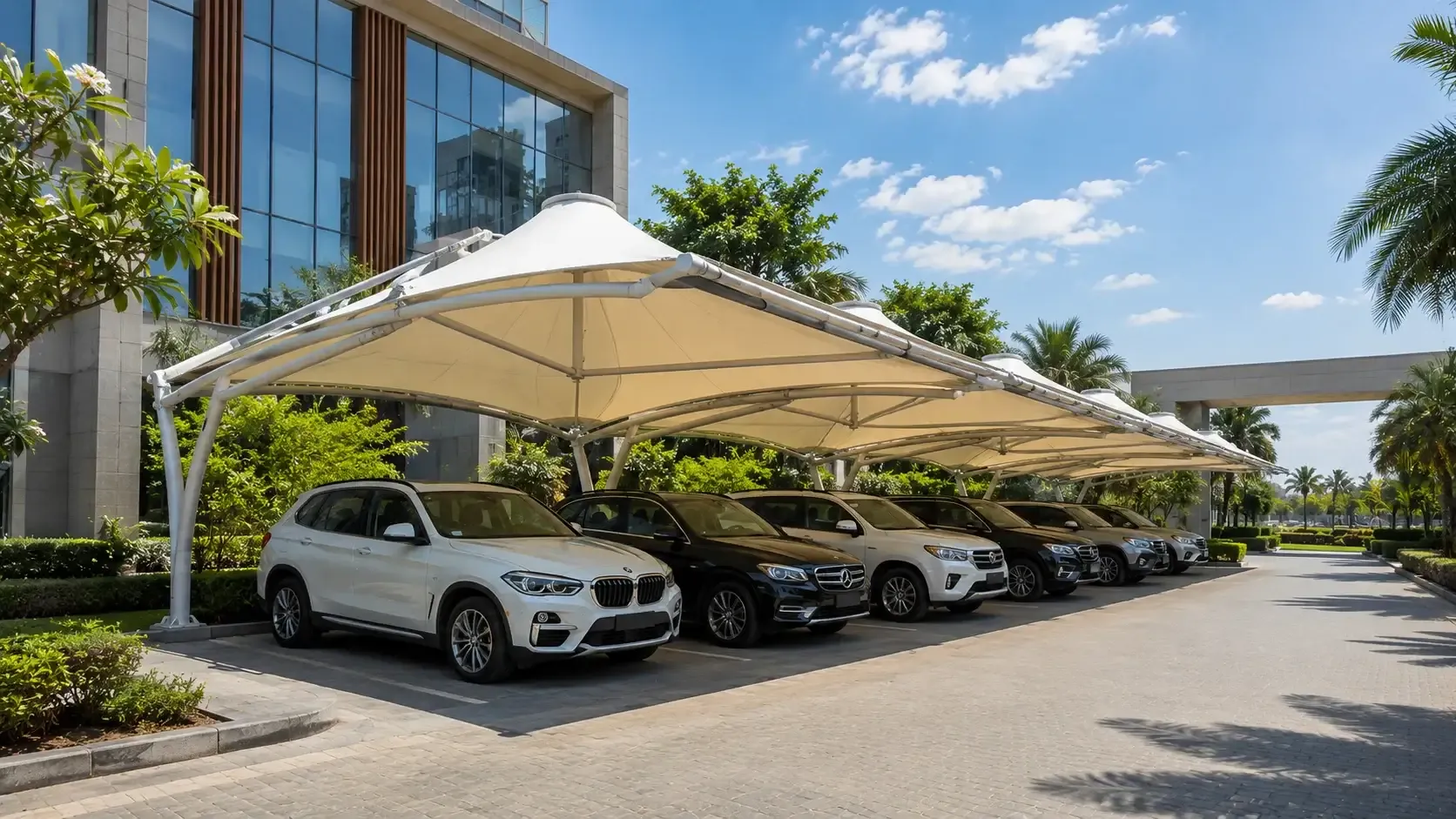
Large, open-sided canopies for fuel stations and depots: tanker headroom, columns out of the way, and branding built into the frame.
In short
Reviewed October 2026
What is a tensile forecourt canopy?
A forecourt tensile canopy is a large, open-sided roof over fuel dispensers, with headroom set by the road tanker and columns placed outside vehicle swept paths. Layout, hazardous zones and approvals come from the fuel operator and the licensing authority. Site work is bolted, with no hot work near live fuelling.
- Headroom
- Set by the road tanker
- Site work
- Bolted, no hot work
- Trading
- Kept open in two phases
Overview
A forecourt has to stay open on every side, tall enough for a road tanker, with columns only where nothing needs to turn. That is close to the worst case for wind uplift.
Headroom is set by the tallest vehicle, the road tanker at its delivery position, and the drainage falls sit above that. Column positions follow the swept paths of cars, trucks and tankers. Foundations are coordinated with buried tanks, product lines and interceptors.
Hazardous zones around dispensers, fill points and vents decide what lighting, cabling and fixings can go where. The layout, zoning and approvals come from the fuel operator, its consultant and the licensing authority, and we build to that route. Steel is welded in the workshop so site work is bolted, with no hot work near live fuelling.
- Headroom
- Set by the road tanker
- Site work
- Bolted, no hot work
- Trading
- Kept open in two phases
- ISO 9001:2015Certified manufacturer
- Since 1998Building membrane structures
- One teamDesign, fabrication and installation
- In writing1-yr structure, 5–15-yr membrane warranty
- ItemisedQuote after a site survey
Forms and layouts
What a forecourt canopy has to get right.
- 01
Clearance
Tanker headroom at the delivery position, with falls designed above it.
- 02
Column layout
Positions taken from vehicle swept paths, so nothing blocks the dispensers.
- 03
Fascia and lighting
Brand bands and high, even, glare-free lighting designed into the frame.
- 04
Phased build
Half the islands keep trading while the other half is built.
Specification
What gets specified.
There is no fixed spec. Structure, membrane and finish are recommended after we have seen the site, the layout, the local wind and the budget.
- Structure
- Large-span open canopy on few columns, designed for site wind under IS 875 (Part 3)
- Membrane
- PVDF for colour hold and dirt shedding; PVC and PVDF typically DIN 4102 B1; PTFE-glass non-combustible
- Steel
- IS 800, hot-dip galvanised to IS 4759 / IS 2629, detailed for wash-down
- Foundations
- IS 456, for uplift and overturning, coordinated with tanks and product lines
- Electrical
- Fittings and cabling to suit the hazardous-zone classification; frame tied into earthing and lightning protection
- Drainage
- Clean roof water kept separate from the forecourt's controlled drainage
- Warranty
- One year on structure and workmanship; five to fifteen years on the membrane, by fabric grade
Price for your site
Four fields. One call back.
- 01We call to understand the site and the use.
- 02We survey: dimensions, ground, access.
- 03You get an itemised quote with the membrane grade named.
The fuel operator, its consultant and the licensing authority set the layout, the hazardous-zone classification and the approval route. We design and build to it.
Usually. Most fabrication is off site and the build is typically split into two phases so half the islands stay open. Excavation near tanks and lines is the slowest part and is sequenced carefully.
It depends on the area, the foundations and the phasing. As a reference, a forecourt of about 3,000 m² built by our group took roughly two and a half months.
Next service
Retractable Roofs
Start a project
Planning a forecourt canopy? Send us the size and location.
Tell us where it is, roughly how big, and what it has to cover. We come back with questions, options and the next step, which is usually a site survey.
or call +91 93159 45187