Materials
The membrane is a structural decision.
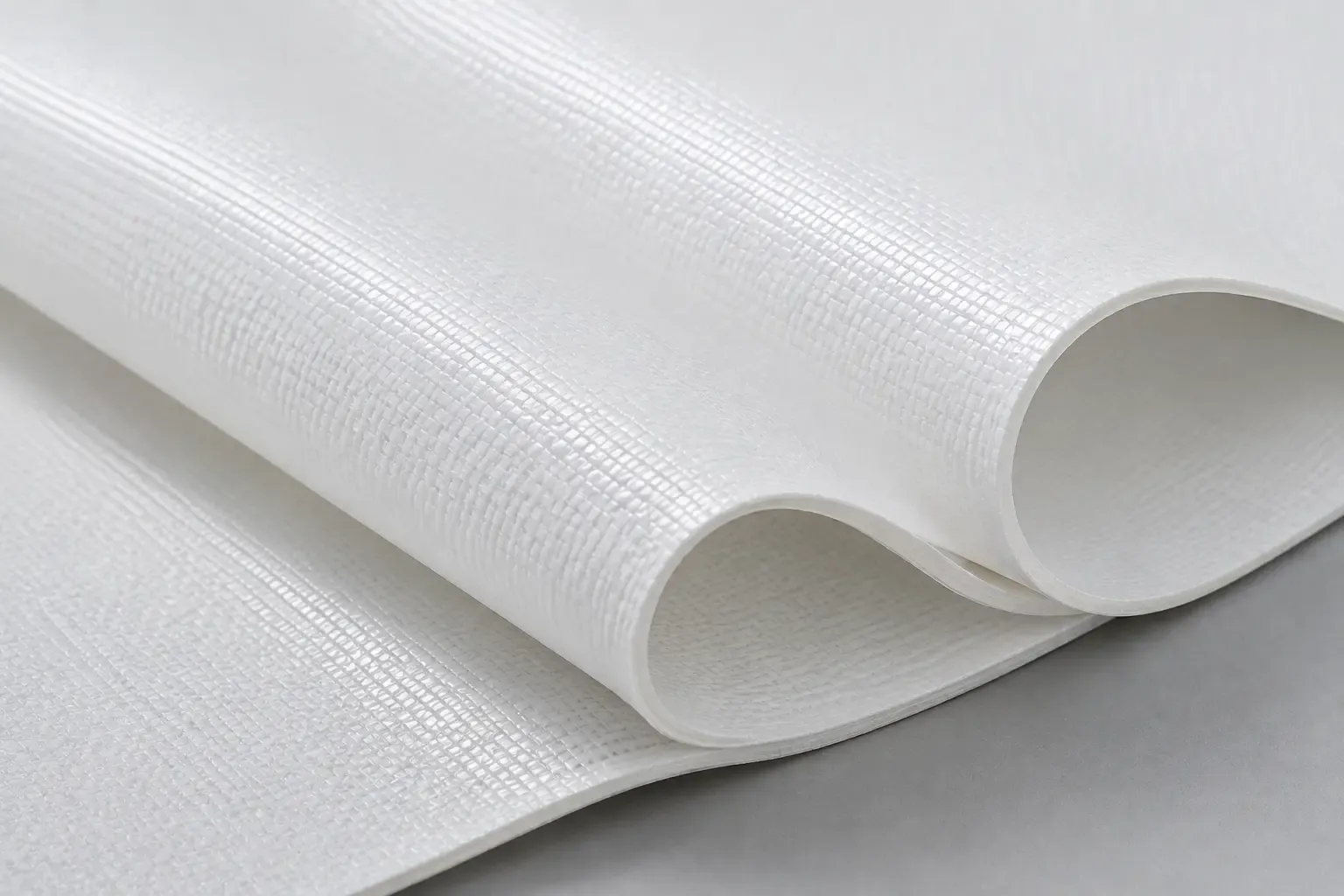
Five families cover almost every project. They differ in what they are made of, how much light they pass, how they age, how they behave in a fire and what they cost.
 Illustrative
No single best
The fabric is a load path, the visible surface and the daylight filter all at once. So it is chosen alongside the form, for the span, the climate, the fire class and the budget. Never after.
The five families
From everyday PVC to landmark PTFE.
- PVCPVC-coated polyester
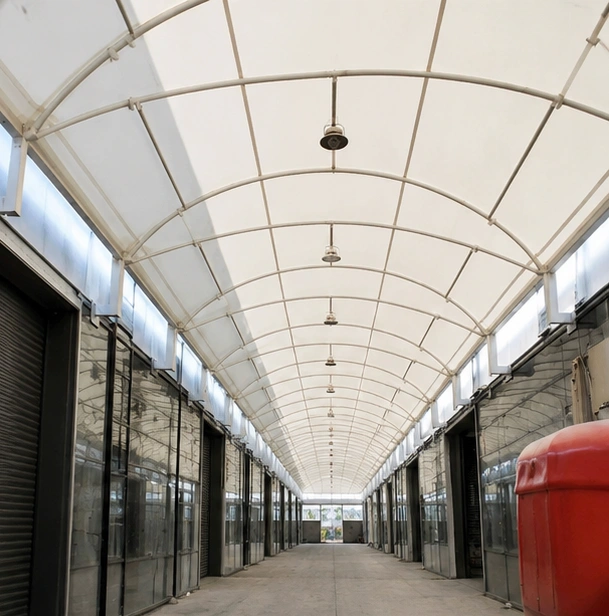
A woven polyester cloth coated in PVC with an acrylic top lacquer. The everyday architectural membrane.
- Best for
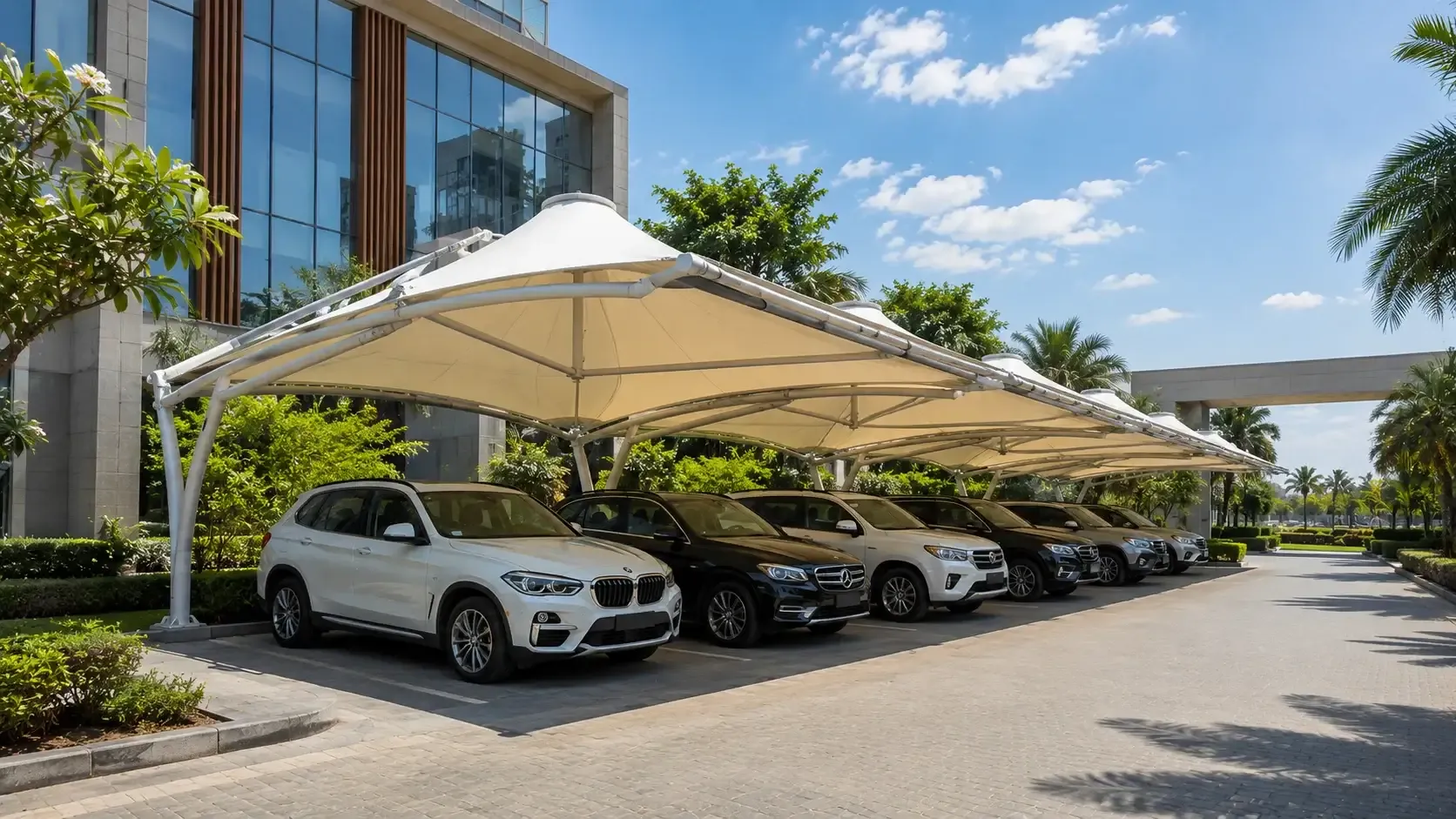
- Car parks, walkways and everyday canopies; wide colour choice; budget-led work.
- Look elsewhere when
- Shorter life than the premium grades; not for a non-combustible requirement.
- Light
- Low
- Fire
- Self-extinguishing B-class
- Cost
- Low
- PVDFPVDF-lacquered PVC
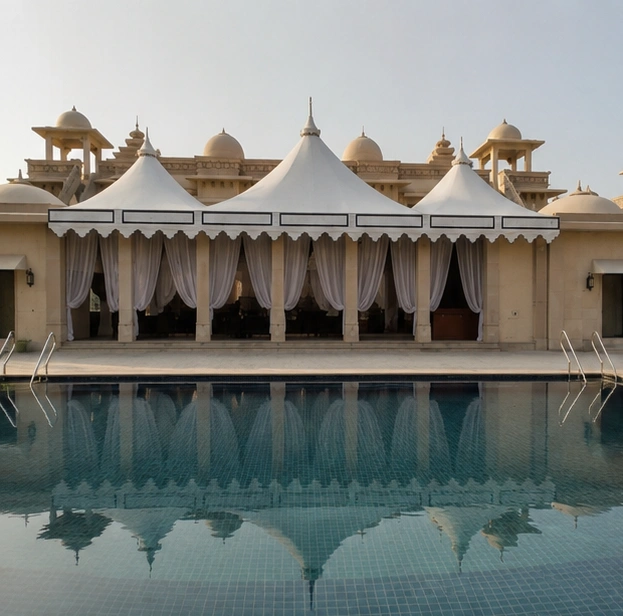
The same PVC-coated polyester with a fluoropolymer top finish that dirt does not key to.
- Best for
- Permanent commercial and public work, where the surface has to stay cleaner and hold colour.
- Look elsewhere when
- Still B-class for fire, and no more light than plain PVC.
- Light
- Low
- Fire
- Self-extinguishing B-class
- Cost
- Low to moderate
- PTFEPTFE-coated glass fibre
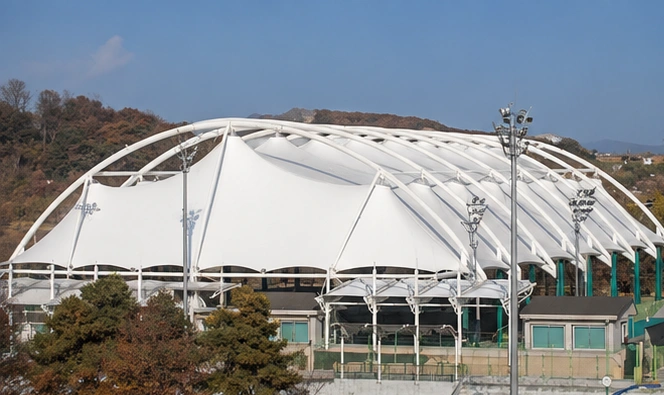
Woven glass fibre with a sintered PTFE coating. Matte white, translucent and self-cleaning in rain.
- Best for
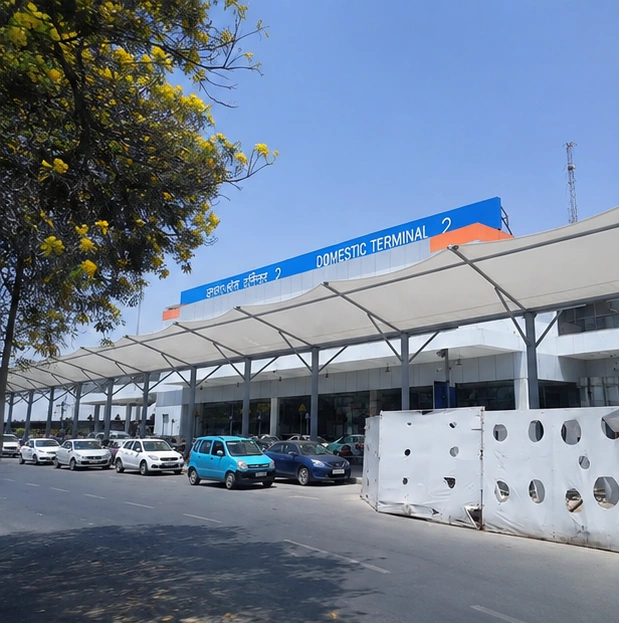
- Airports, stadiums, atria and civic landmarks; anywhere a non-combustible class is required.
- Look elsewhere when
- Cost, white only, cannot be folded, longer lead time.
- Light
- Moderate, diffusing
- Fire
- Non-combustible A2-class
- Life
- Often 25–30 years and more
- ETFEETFE film
An extruded fluoropolymer film with no base cloth, used as a single skin over a cable net or as inflated cushions.
- Best for
- Medium to large daylit roofs where transparency is the point.
- Look elsewhere when
- Puncture-prone; needs a cable net or an air supply, so the system cost is high.
- Light
- High
- Fire
- Self-extinguishing; melts and vents
- Cost
- High, as a system
- HDPEHDPE shade mesh
A knitted open mesh of HDPE yarn. Shade and airflow, not a waterproof roof.
- Best for
- Shade sails over play areas, seating and decks where some rain is acceptable.
- Look elsewhere when
- Anywhere the brief says dry. Choosing mesh to save cost on a job that needs a roof is the most common material mistake.
- Rain
- Passes through
- Life
- Shorter than coated membranes
- Cost
- Lowest
Side by side
The four weatherproof membranes compared.
Typical characteristics, not product data. The exact figure for a project comes from the chosen product's datasheet and the site. Shade mesh is left out because it is not waterproof.
Fire classification
Reaction to fire, not fire resistance.
A membrane roof is not a fire barrier and is never specified as one. The classes below describe how a material contributes to a fire. They are typical for the family; only the test certificate for the supplied product proves it, and we supply it for whatever class is specified.
A reaction-to-fire class: difficult to ignite and self-extinguishing. Still the most quoted figure for architectural fabric.
Classes A1 to F, plus an s rating for smoke (s1 = least) and a d rating for flaming droplets (d0 = none).
A pass/fail flame-propagation test for textiles, common for tent and membrane fabrics.
These systems do not convert into one another. If the authority names one standard, a certificate against another is not a substitute.
Which class you need
Decided by the occupancy and the authority.
Airports, malls, stadiums, large atria
Non-combustible PTFE-coated glass is the usual specification, and often the only one accepted.
Schools, hospitals, hotels
Stricter requirements for vulnerable or sleeping occupants. Confirm with the authority before specifying.
Open car parks and walkways
Away from a building line, the least demanding case. B1 membranes are commonly accepted.
Interior ceilings
Inside the building's fire strategy, usually the strictest case of all.
Start a project
Not sure which membrane? Tell us what it has to do.
Share the use, the location and any fire or authority requirement. We recommend a grade and name it in the quotation.
or call +91 93159 45187