Glossary
The words behind the fabric.
32 terms you will meet in a tensile structure quote, drawing or inspection report, defined in plain English.
A
- Anticlastic surface
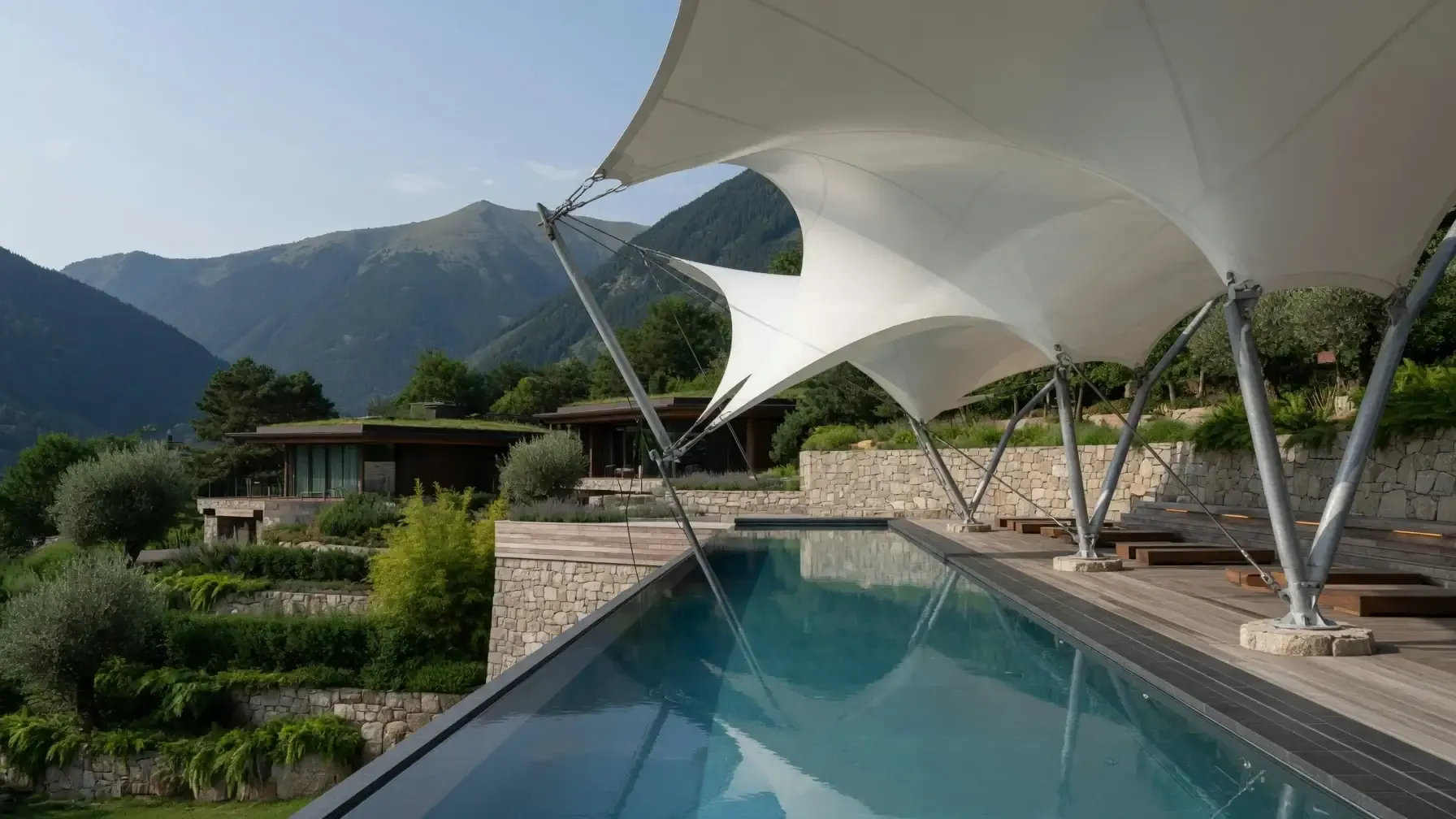
- A surface that curves up in one direction and down in the other, like a saddle. Every stable tensile membrane is anticlastic, because the two opposing curvatures keep it taut under both rain and wind suction. Read more
B
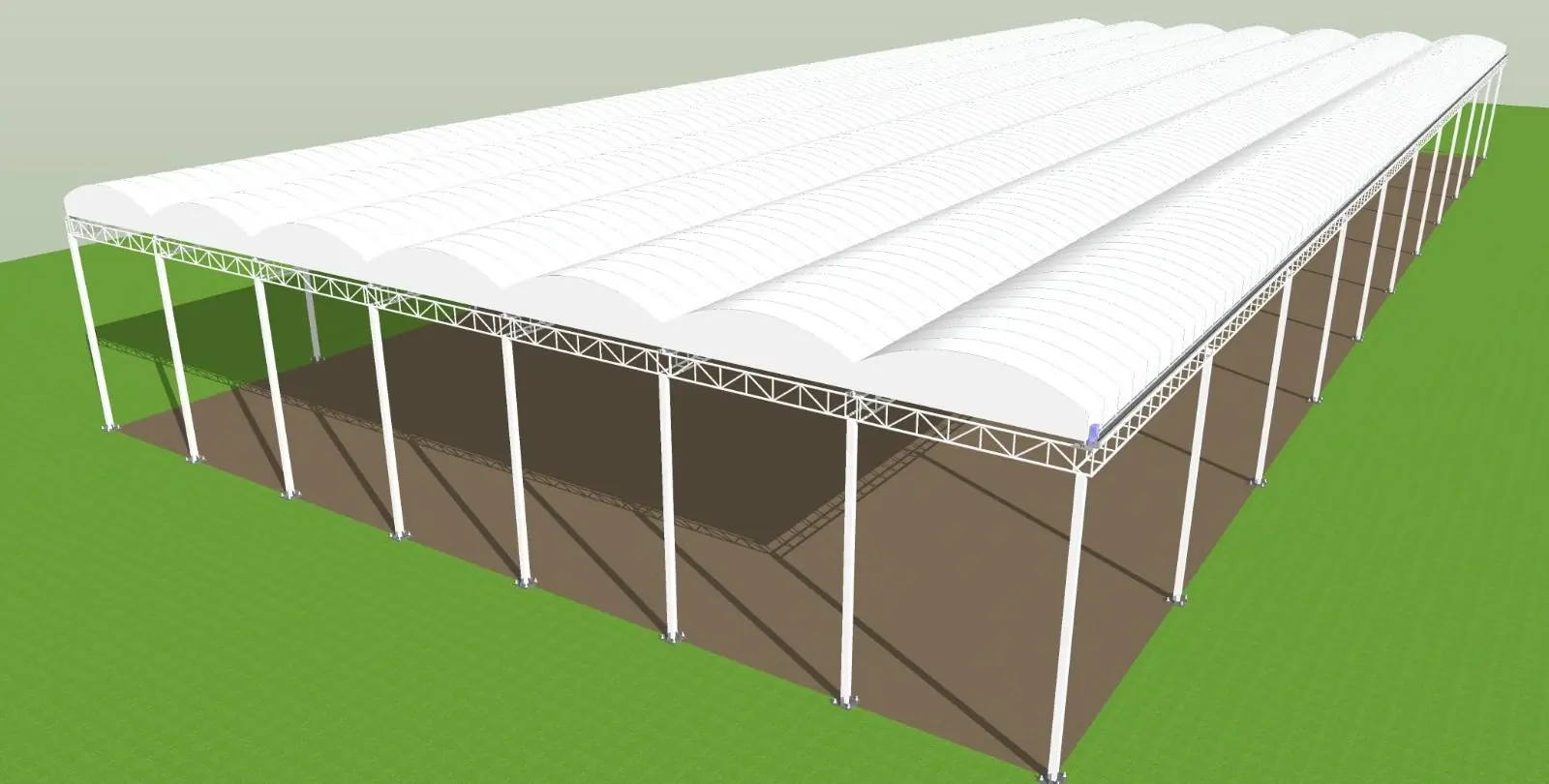
- Barrel vault
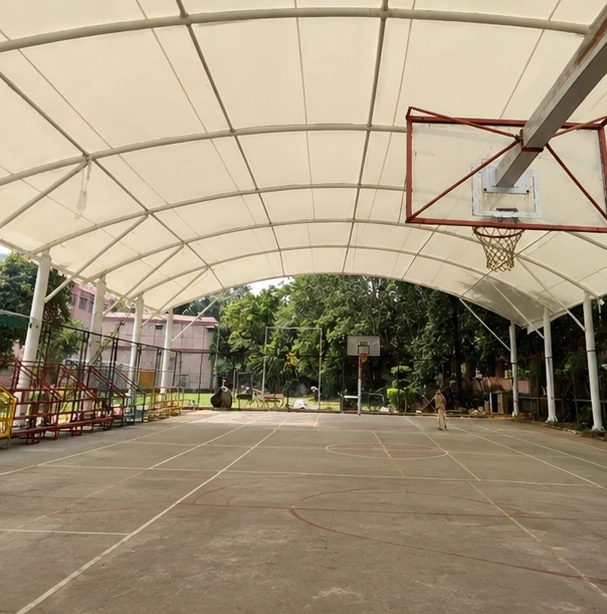
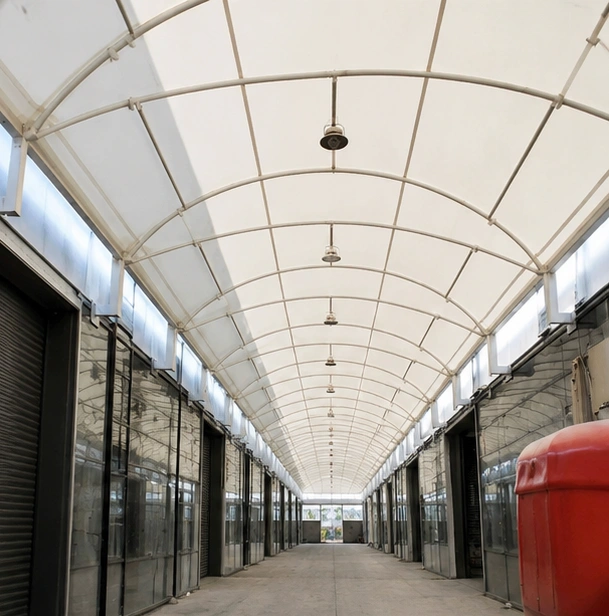
- A membrane roof shaped like a long arch, repeated along a length. Common over walkways, lap pools and long industrial bays. Read more
C
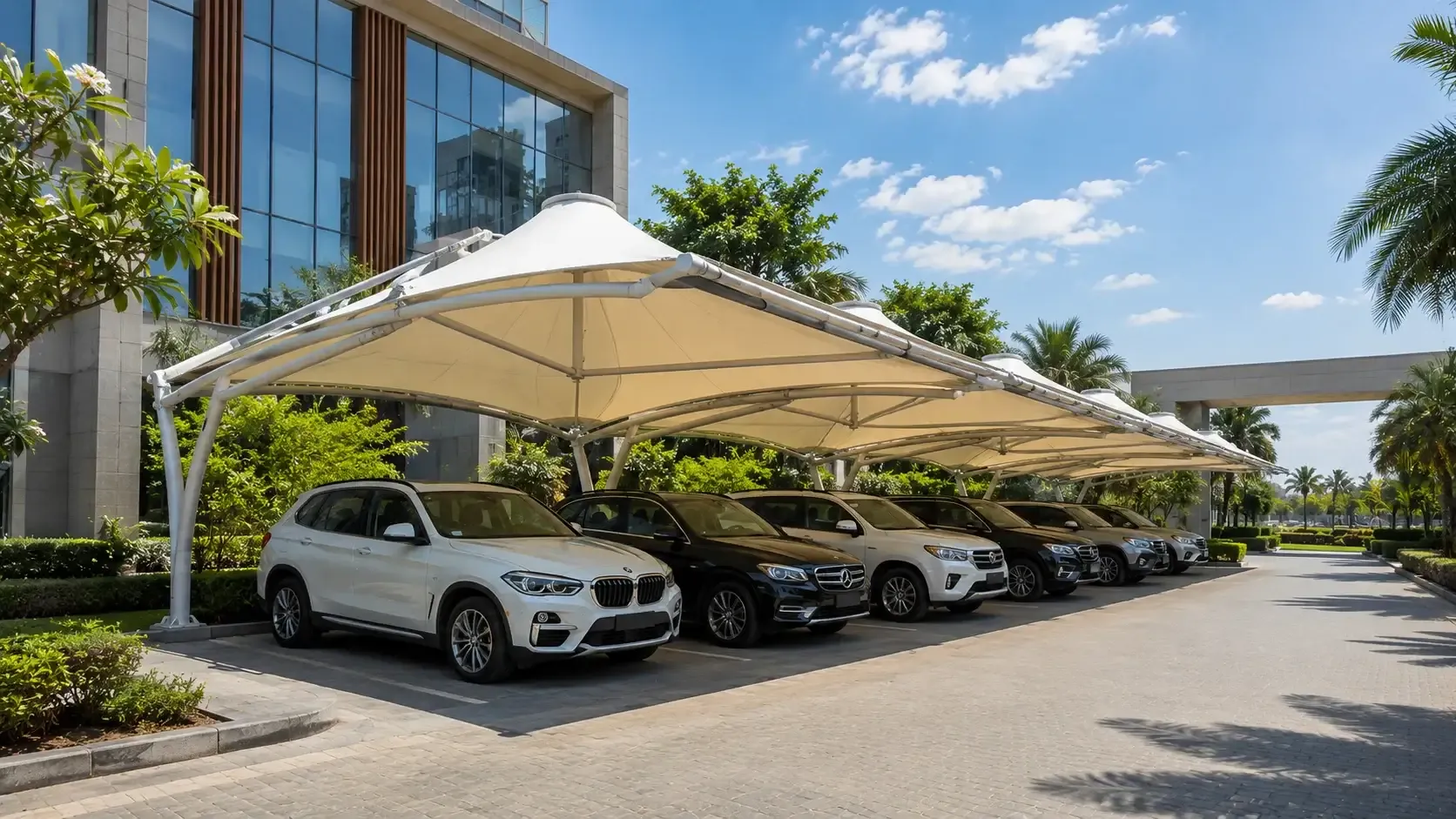
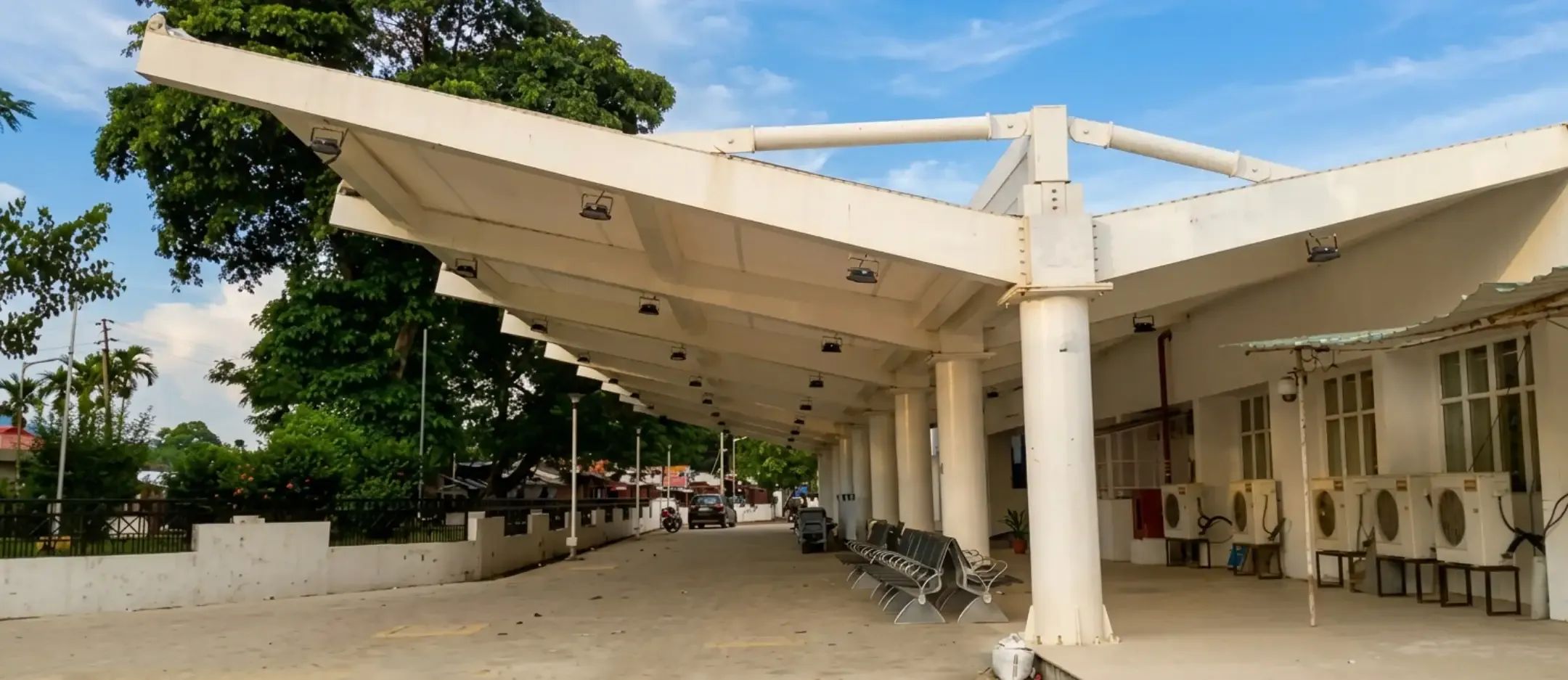
- Cantilever
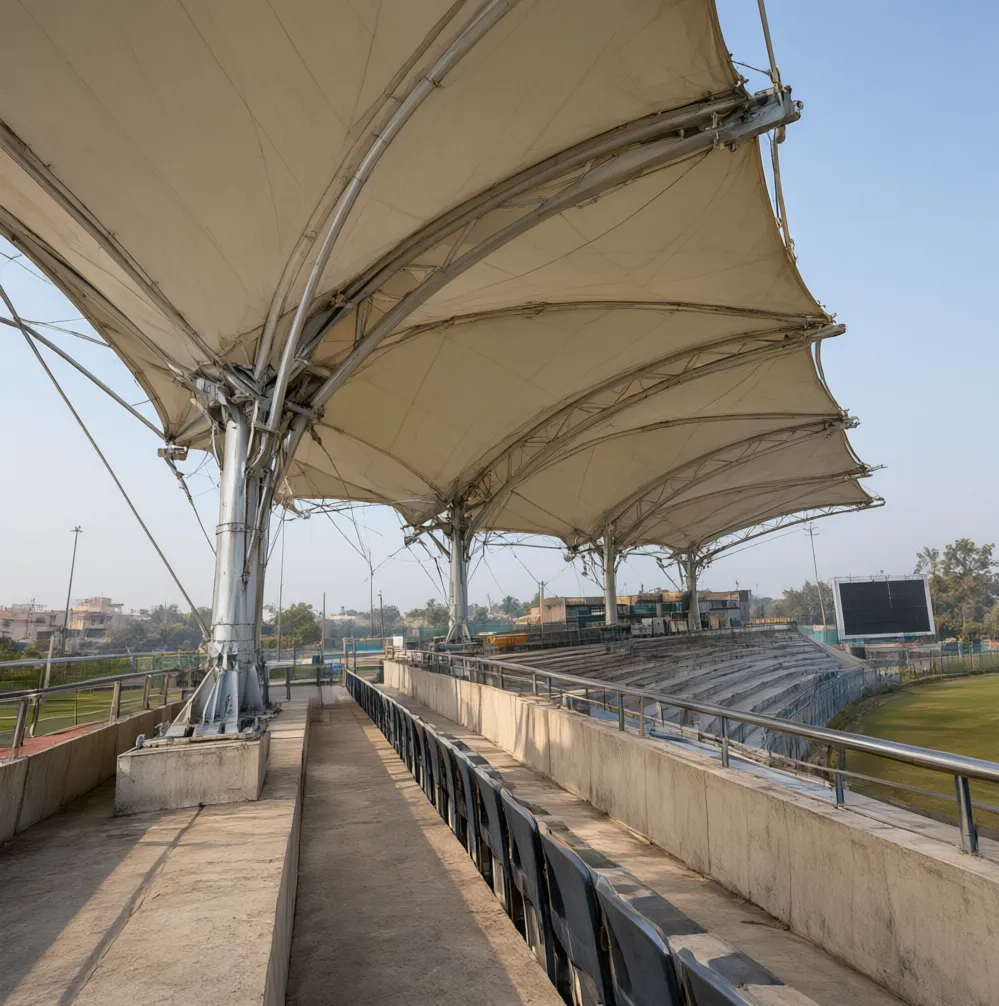
- A structure supported along one edge only, leaving the other edge clear. The usual layout for car parking shades and spectator stands. Read more
- Clamp plate
- The steel plate that grips the edge or corner of a membrane and transfers its tension into the frame. A place to check for wear during inspections.
- Conical structure
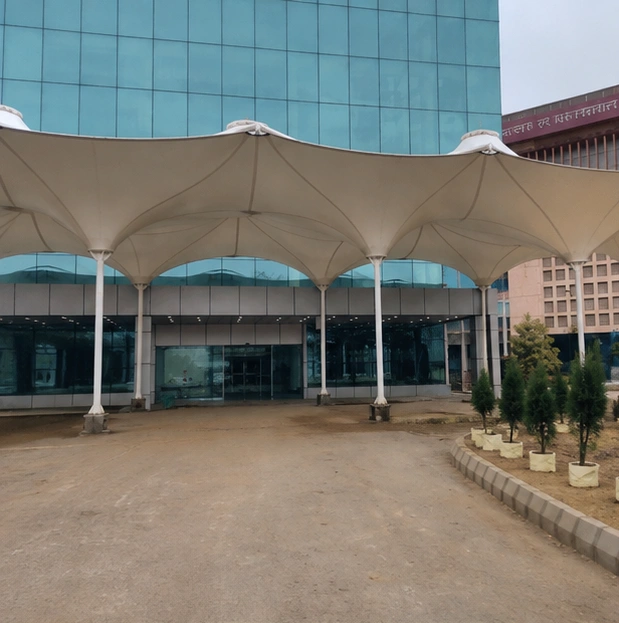
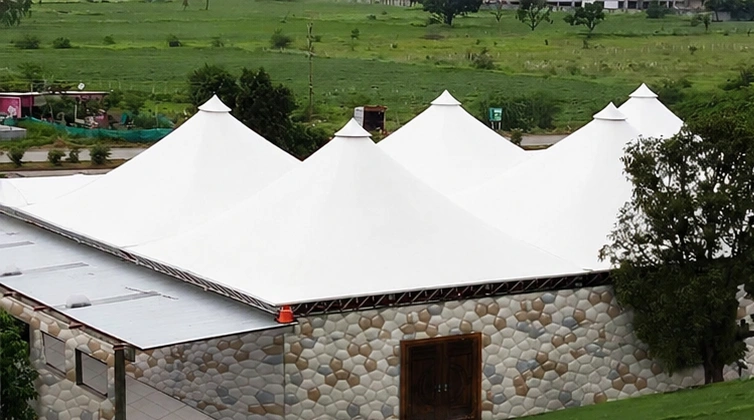
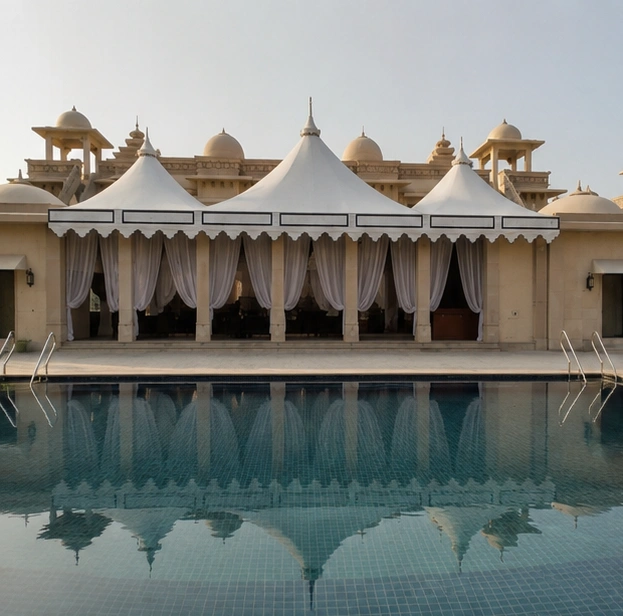
- A membrane drawn up to a high ring on a central mast, falling to a lower perimeter. Self-draining and instantly recognisable. Read more
D
- Dead load
- The weight of the structure itself: membrane, cables and steel. On a tensile roof it is small, which is why wind uplift usually governs the design.
- DIN 4102 B1
- A German reaction-to-fire class meaning a material is difficult to ignite and self-extinguishing. Commonly quoted for PVC and PVDF membranes. It is not the same as non-combustible. Read more
- Double curvature
- Curvature in two directions at once. Combined with pre-stress, it is what gives a thin membrane its stiffness.
E
- Edge cable
- A steel cable running in a pocket or along the free edge of a membrane, pulling the edge into a curve and carrying its tension to the corners.
- EN 13501-1
- The European reaction-to-fire classification, from A1 (non-combustible) to F, with extra ratings for smoke (s) and flaming droplets (d). PTFE-coated glass typically reaches A2-s1,d0. Read more
- ETFE
- Ethylene tetrafluoroethylene: a transparent fluoropolymer film used as single-layer panels over a cable net or as inflated cushions. Light and clear, but puncture-prone. Read more
F
- Form-finding
- Working out the shape a tensioned membrane naturally takes under its boundary conditions and pre-stress, usually by computer. The shape comes first; the steel is designed around it. Read more
G
- Galvanising
- Coating steel in zinc by dipping it in molten zinc, to protect it from corrosion. In India it follows IS 4759 and IS 2629.
H
- HDPE shade net
- A knitted open mesh of HDPE yarn used for shade sails. It cuts sun and lets air through, but it is not waterproof. Read more
- HF welding
- High-frequency welding, which fuses PVC-coated membrane panels together. A good welded seam is as strong as the fabric around it.
- Hypar (hyperbolic paraboloid)
- A four-cornered membrane with two high and two low points, twisted into a saddle. Efficient over square bays and striking from below.
I
- IS 875 (Part 3)
- The Indian Standard for wind loads on buildings and structures. It gives the basic wind speed for a location, adjusted for terrain, height and the importance of the structure. Read more
M
- Mast
- A compression member, usually a steel tube, that holds a point of the membrane up, as at the peak of a cone.
P
- Patterning
- Cutting the curved 3D membrane shape into flat panels, oriented to the fabric's weave and compensated for stretch, so it fits exactly once tensioned.
- Ponding
- Water collecting in a sagging area of membrane. A sign of lost tension or poor form, and a cause of overload and early wear. Read more
- Pre-stress
- The tension deliberately introduced into a membrane when it is installed. It keeps the surface taut and stable and permanently pulls on the frame and footings.
- PTFE-coated glass fibre
- A woven glass-fibre cloth sealed in PTFE. Non-combustible, self-cleaning and long-lived (25–30+ years), but white only and more expensive. Read more
- PVC-coated polyester
- A woven polyester cloth coated in PVC with a protective top lacquer. The most widely used architectural membrane: economical, colourful and easy to weld. Read more
- PVDF lacquer
- A thin fluoropolymer top coat applied over PVC-coated polyester. It sheds dirt in rain, holds colour and extends the membrane's life to around 20–25 years. Read more
R
- Re-tensioning
- Restoring a membrane to its design pre-stress after it has relaxed over time. Part of annual maintenance and the best defence against ponding and flutter. Read more
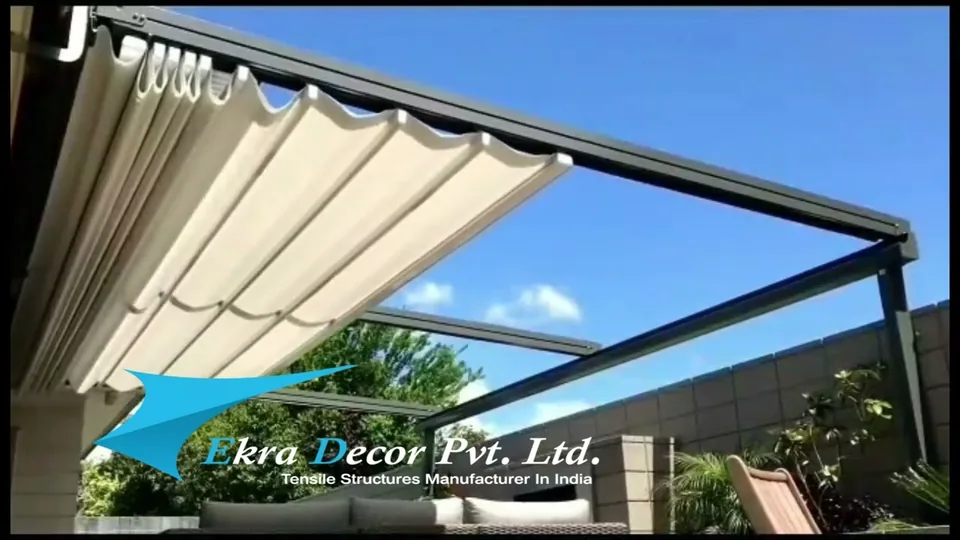
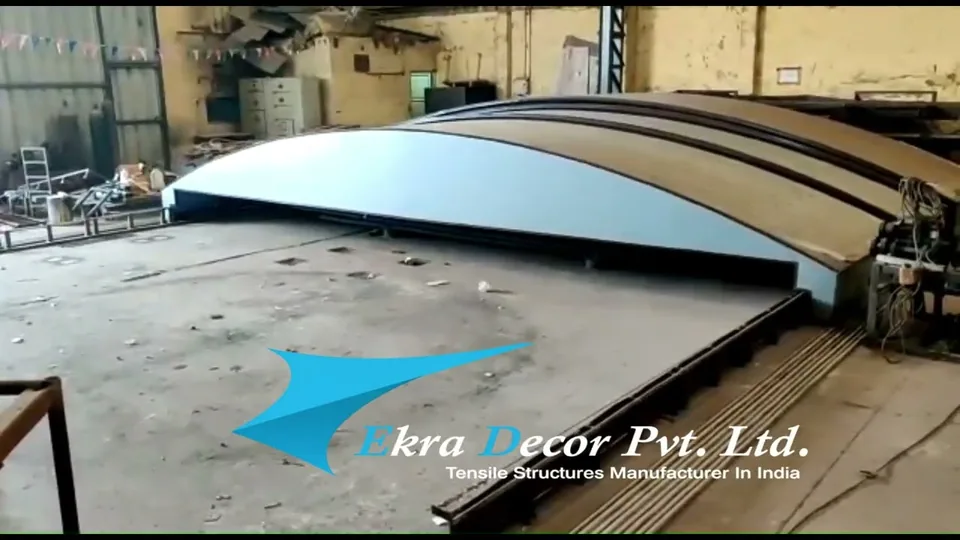
- Retractable roof
- A roof whose membrane bays travel on rails, driven by motors, so the space can be opened to the sky and closed again. Read more
- Ridge and valley
- A roof of alternating high ridge cables and low valley cables, used to span very wide spaces. The valleys double as drainage lines.
T
- Translucency
- The share of daylight a membrane lets through. Coated fabrics pass roughly 5–20% as soft, diffuse light; clear ETFE passes far more.
- Turnbuckle
- An adjustable threaded fitting on a cable or rod, used to set and later re-adjust tension.
U
- Uplift
- Upward suction from wind passing over and under a roof. On a light tensile structure it is usually the governing load, and it is what the footings are sized against.
V
- Valley gutter
- A gutter running along the low line between two membrane surfaces, as between back-to-back car parking rows.
W
- Warp and weft
- The two thread directions of a woven fabric. They stretch differently, so membrane panels are always cut to a set orientation.
Start a project
Still a term too many? Ask an engineer.
Tell us where it is, roughly how big, and what it has to cover. We come back with questions, options and the next step, which is usually a site survey.
or call +91 93159 45187