

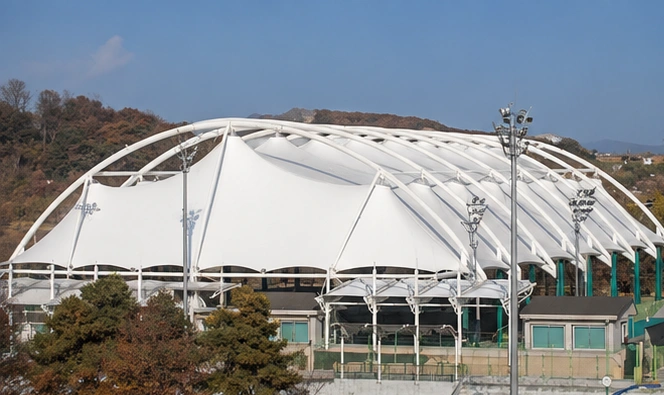

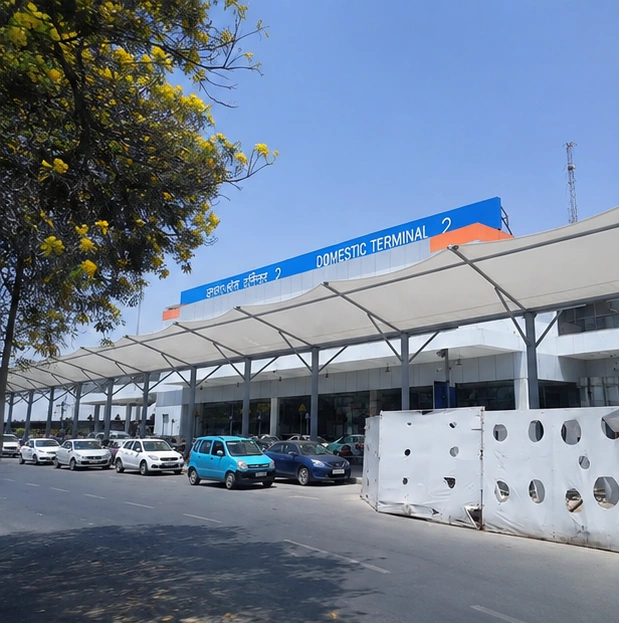
Material 04 — ETFE film
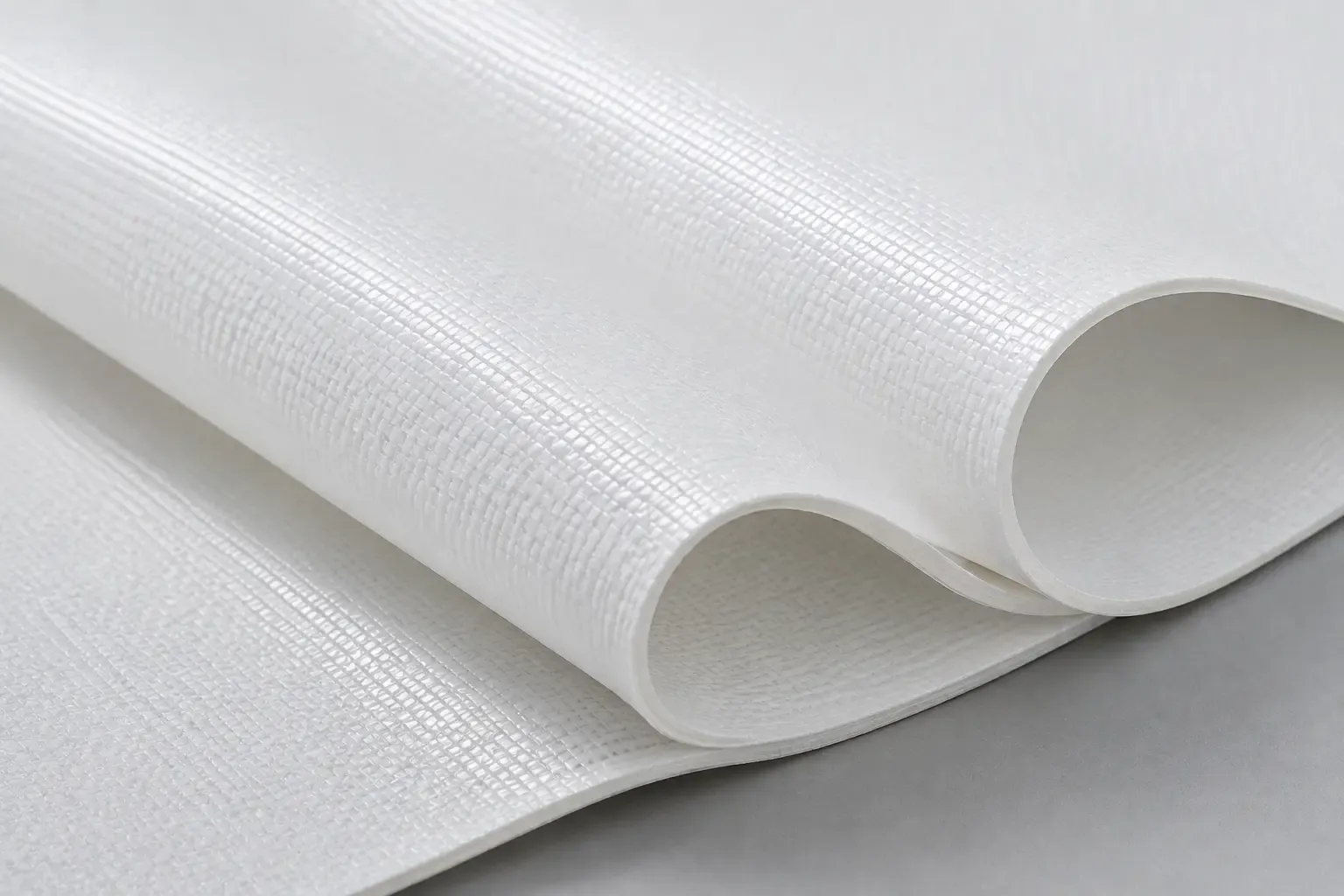
ETFE membrane.
Not a fabric at all: an extruded fluoropolymer film, 0.1–0.3 mm thick, used where a roof needs to be close to glass in clarity at a fraction of the weight.
Why it is used
With no woven cloth inside, ETFE has almost no stiffness of its own. It spans by being tensioned over a close net or frame, or by being inflated into cushions.
How it is built up
Layer by layer.
- 01
Single-layer film
Tensioned over a closely spaced cable net or frame. Simpler, with no air supply.
- 02
Inflated cushions
Two or more layers welded into cushions and kept inflated by a continuous air supply. Better insulation, larger panels.
- 03
Printed frit
A printed pattern on one or more layers to control light and solar gain.
Typical characteristics
The numbers, with their caveats.
- Thickness
- ≈ 100–300 µm per layer
- Weight
- ≈ 0.15–0.35 kg/m² per layer
- Light transmission
- ≈ 88–95% for clear film
- Fire
- Commonly B-s1,d0 / B1: self-extinguishing, low smoke
Typical ranges for the material class. The exact figure comes from the datasheet of the product we specify, checked against your project's structural and fire requirements.
Grades and options
How ETFE differs from the woven membranes.
Load path
Needs a support net, a frame, or air pressure. A woven fabric spans on its own between supports.
Transparency
Near-glass clarity, against diffuse light only from coated fabrics.
Puncture
Low resistance, so it is kept out of reach and patch-repaired.
Services
Cushions need a continuous air supply and the power to run it.
Choose it for
- Atria and courtyards where daylight is the point
- Very light roofs over existing structures
- Facades and skylights needing clarity
Look elsewhere when
- You want diffuse, glare-free light
- Acoustic mass or privacy matters
- The budget is tight, or no air supply can be maintained
FAQ
Common questions.
No. ETFE is a thin fluoropolymer film that is tensioned or inflated. Polycarbonate is a rigid plastic sheet. ETFE is lighter and stays clearer for longer, but it costs more as a system.
Cushion systems do: they need a continuous air supply to stay inflated. Single-layer film over a net does not.
Start a project
Not sure which membrane? Tell us what it has to do.
Tell us where it is, roughly how big, and what it has to cover. We come back with questions, options and the next step, which is usually a site survey.
or call +91 93159 45187